
 Türkçe
 Deutsch
 Français
Hair loss affects both men and women, impacting self-confidence and quality of life. In 2026, hair transplant technology delivers natural-looking, permanent results through minimally invasive techniques such as FUE and DHI. In this comprehensive guide, we explain how hair transplantation works, the differences between FUE and DHI, what to expect before and after the procedure, and why Turkey has become the most preferred destination worldwide for hair restoration.
What Is a Hair Transplant?
A hair transplant is a surgical procedure in which healthy hair follicles are harvested from a donor area — typically the back of the scalp, which is genetically resistant to hair loss — and transplanted to areas affected by thinning or baldness. The transplanted follicles retain their genetic characteristics and continue to grow permanently in their new location.
Hair transplantation is also successfully applied to the hairline, eyebrows, beard and moustache areas. Learn more about hair transplant treatments at EFC Clinic.
Who Is a Good Candidate?
- Male pattern baldness: Norwood Scale Type 2-6 cases are ideal candidates.
- Female pattern hair loss: Suitable for women with diffuse thinning and adequate donor density.
- Receding hairline: Hairline design for those whose forehead-hairline boundary has risen.
- Trauma or scarring: Filling hair gaps caused by accidents, burns or previous surgeries.
- Eyebrow and beard transplant: Follicle transfer to fill sparse eyebrows or beard areas.
FUE Technique (Follicular Unit Extraction)
FUE is the most widely used hair transplant technique today. Individual follicles are extracted one by one from the donor area using a micro-punch tool and placed into channels in the recipient area. Because it leaves no linear scar, it is ideal for patients who prefer to wear their hair short.
Advantages of FUE
- No linear scar; virtually undetectable even with a short haircut
- Fast recovery; most patients return to daily life within 3-5 days
- Wide donor options; grafts can be taken from beard, chest or body hair
- Graft survival rates of 95% or above in experienced hands
Sapphire FUE
Sapphire FUE uses V-shaped sapphire tips instead of steel tips to open channels. Sapphire tips allow smaller, cleaner openings, reducing tissue damage, accelerating healing and increasing graft density. EFC Clinic applies Sapphire FUE as the primary approach in high-density cases.
DHI Technique (Direct Hair Implantation)
DHI is an advanced technique in which follicles are implanted directly without pre-opening channels, using a Choi implanter pen. Channel opening and placement occur in a single step, unlike FUE.
Advantages of DHI
- Unshaved transplant: The procedure can be performed without shaving existing hair
- Higher density: Follicles can be placed at closer intervals for a denser appearance
- Precise angle control: The Choi pen ensures each follicle grows at a natural angle
- Less tissue trauma: No pre-opened channels means less bleeding and crust formation
FUE vs. DHI: Which Is Right for You?
- Large areas and high graft counts: FUE or Sapphire FUE is more practical
- Prefer not to shave: DHI is ideal
- Adding density between existing hair: DHI provides more precise placement
- Budget-conscious: FUE is generally more economical
Contact EFC Clinic specialists for a free consultation.
Procedure Steps
- Consultation and Planning: Degree of hair loss, donor capacity and personal expectations are assessed. Digital hairline design is performed.
- Preparation: The donor area is shaved and local anaesthesia is administered. No pain is felt after anaesthesia.
- Graft Extraction: Follicles are extracted one by one. This stage may take 2-4 hours depending on graft count.
- Channel Opening (FUE): Micro-incisions are made in the recipient area at the correct angle and density.
- Graft Placement: Follicles are placed into the opened channels or directly (DHI).
- First Wash and Aftercare Training: The patient receives aftercare instructions at the clinic the following day.
Recovery Process and Expected Results
- Days 0-3: Mild swelling, crusting and sensitivity are normal
- Days 7-14: Crusts shed; transplanted hairs begin to fall out due to shock loss — this is normal
- Months 1-3: New hair growth begins, initially thin and matte
- Month 6: Noticeable fullness and density; hair gradually thickens
- Months 12-18: Final result emerges; natural appearance is fully established
With proper aftercare, the success rate of hair transplantation reaches 95% or above.
Why Turkey and EFC Clinic?
Turkey ranks first globally in hair transplant tourism. The same quality procedures are performed in Turkey at 70-80% lower cost compared to Western Europe and the USA.
- Experienced hair transplant surgeons and specialist technicians
- Expertise across FUE, Sapphire FUE and DHI techniques
- Digital hairline design and Norwood/Ludwig analysis
- Transfer and accommodation coordination on the day of surgery
- Patient communication in TR / EN / FR / DE
- Remote post-operative follow-up and free check-up
Learn about our international patient services or meet our specialist doctors.
Frequently Asked Questions
Is a hair transplant permanent?
Yes. The transplanted follicles are genetically resistant to hair loss and continue to grow for life.
Is the procedure painful?
No pain is felt during the procedure under local anaesthesia. The anaesthetic injection may cause a brief burning sensation that passes within seconds.
How many grafts are needed?
1,000-1,500 grafts for a mild receding hairline; 2,500-3,500 for moderate loss; 4,000-6,000 for advanced cases.
When can I return to work?
Desk workers can generally return within 3-5 days. Physical activity should be avoided for 2-3 weeks.
Can women have hair transplants?
Yes, it is successfully performed in women with adequate donor density.
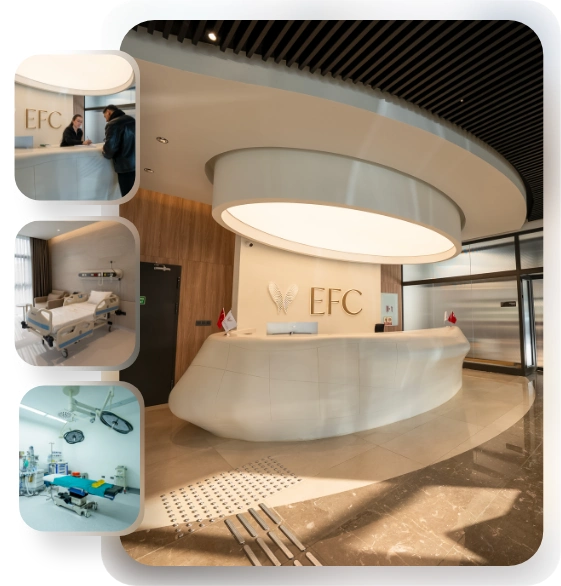
Comprehensive Care: From the First Examination to the Follow-Up Process.
EFC CLINIC is a center of excellence specializing in the most rigorous fields of surgical medicine—from aesthetic surgery to interventional treatments—where every step is carried out with meticulous care. Medical excellence, aesthetic precision, and an uncompromising ethical stance meet on the same line. Our subspecialty-trained specialists aim to achieve natural and reliable results by providing evidence-based care with modern imaging, standardized protocols, and safety systems. From consultation to recovery, your care is coordinated end-to-end with clear communication, transparent planning, and genuine respect for your health.
