
 Türkçe
 Deutsch
 Français
Breast augmentation is one of the most frequently requested plastic surgery procedures worldwide. In 2026, breast augmentation surgery delivers more predictable and natural results thanks to advanced implant technology and surgical planning software. This complete guide covers everything from implant types to surgical techniques, recovery and the advantages of treatment in Turkey.
What Is Breast Augmentation?
Breast augmentation, medically known as augmentation mammoplasty, is a procedure that improves breast volume, fullness and shape by placing an implant under the breast tissue or muscle, or through fat grafting. The goal is not simply a “bigger” look but a result proportionate to the body and natural in appearance. The procedure is chosen for various reasons, including naturally small breast volume, asymmetry, or volume loss following pregnancy or weight changes.
Implant Types
The most commonly used implant type for breast augmentation is the natural-feeling silicone gel implant. Two basic shape options are available:
- Round implants: Often preferred by patients seeking upper-pole fullness and a more pronounced décolletage.
- Anatomical (teardrop) implants: Preferred by patients seeking a more natural slope and a softer transition line.
The choice between smooth and microtextured surfaces depends on the patient’s tissue characteristics and the surgeon’s experience. Modern implants are generally considered usable for a lifetime by manufacturers, with most offering a 10-year warranty.
Methods: Implants and Fat Transfer
Augmentation With Silicone Implants
The most commonly performed method, offering long-lasting results. The implant can be placed under the breast tissue (subglandular) or under the muscle (submuscular), with the choice determined by the surgeon based on tissue thickness.
Fat Transfer (Fat Grafting)
Fat harvested via liposuction from another area of the body (typically the abdomen, flanks or thighs) is purified and injected into the breast. This less invasive method suits patients who prefer using their own tissue and seek a mild-to-moderate volume increase.
Incision and Placement Options
The most commonly used incision options for implant placement include:
- Inframammary fold incision: Provides the surgeon with wide visibility without disturbing the glandular tissue.
- Periareolar incision: Hidden within the colour transition zone, becoming less noticeable over time.
- Transaxillary incision: Performed endoscopically for patients who prefer no visible scarring on the breast itself.
For patients with mild sagging, combining augmentation with a breast lift (mastopexy) rather than volume increase alone can achieve a more balanced result.
Who Is a Good Candidate?
Good candidates for breast augmentation are generally:
- At least 18 years old with completed breast development
- In overall health suitable for surgery
- Dissatisfied with their breast shape, size or symmetry
- Informed about the realistic outcomes of the procedure
Patients with uncontrolled chronic illness, active infection or untreated breast disease require thorough medical evaluation before the procedure.
The Surgical Process
- Consultation: Chest measurements, breast tissue thickness, asymmetry assessment and clarification of expectations.
- Planning: Determining implant shape, size, surface texture, incision location and placement plane (subglandular/submuscular).
- Anaesthesia: The procedure is performed under general anaesthesia.
- Surgical Procedure: Through the chosen incision, a pocket is prepared, the implant is placed and the incision is closed with specialised suturing.
Surgery generally takes 1–3 hours; this may extend when combined with a breast lift.
Recovery Process
Tightness and swelling are expected in the first few days after surgery, gradually subsiding over time. Most patients can begin walking within a few hours of the procedure. Avoiding heavy lifting and chest-straining activities in the first weeks, wearing a medical bra, and following the surgeon’s follow-up schedule directly affect the quality of the final result. Full tissue settling and shape stabilisation can take several months.
Why Turkey and EFC Clinic?
Turkey is one of the world’s leading medical tourism destinations for breast augmentation, supported by experienced plastic surgeons, internationally accredited hospitals and competitive treatment processes. At EFC Clinic, breast augmentation procedures are planned individually by our specialist plastic surgery team. Multilingual support is provided in Turkish, English, French and German. Contact us for detailed information and an appointment.
Frequently Asked Questions
Do breast implants last a lifetime?
Modern implants are considered long-lasting, though implant rupture can rarely occur. Annual ultrasound check-ups are recommended.
Does breast augmentation affect breastfeeding?
With the right technique and incision choice, the implant is generally placed without disturbing the milk ducts; however, individual assessment by the surgeon is essential.
How long does the procedure take?
Surgery typically takes 1–3 hours, and patients can usually be discharged the same day or after one night in hospital.
Is fat transfer more natural than implants?
Fat transfer uses your own tissue and can feel more natural, but the achievable volume increase is more limited compared to implants.
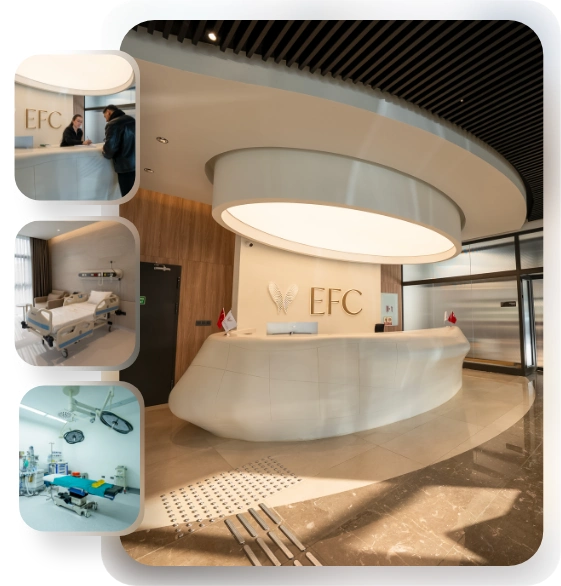
Comprehensive Care: From the First Examination to the Follow-Up Process.
EFC CLINIC is a center of excellence specializing in the most rigorous fields of surgical medicine—from aesthetic surgery to interventional treatments—where every step is carried out with meticulous care. Medical excellence, aesthetic precision, and an uncompromising ethical stance meet on the same line. Our subspecialty-trained specialists aim to achieve natural and reliable results by providing evidence-based care with modern imaging, standardized protocols, and safety systems. From consultation to recovery, your care is coordinated end-to-end with clear communication, transparent planning, and genuine respect for your health.
