
 Türkçe
 Deutsch
 Français
As we age, sagging, wrinkles and loss of elasticity in the face can make a person look older than they feel. In 2026, facelift surgery delivers natural, long-lasting and subtle results thanks to modern surgical techniques. This complete guide covers everything from what a facelift is to its techniques, recovery process and the advantages of treatment in Turkey.
What Is a Facelift?
A facelift, medically known as rhytidectomy, is a surgical aesthetic procedure designed to address the visible signs of ageing in the face and neck. During the procedure, the SMAS (Superficial Musculo-Aponeurotic System) layer beneath the skin is repositioned, excess skin is removed and facial contours are restored to a more youthful appearance. Modern facelifts are no longer simply “skin pulling” — they involve three-dimensional repositioning of the deeper tissue layers.
What Signs Does It Address?
Facelift surgery is typically chosen to correct:
- Noticeable sagging in the cheeks and jawline
- Deep nasolabial folds (lines between the nose and mouth)
- Loose skin under the chin and neck (“turkey neck”)
- General loss of skin elasticity
- A tired appearance caused by overall volume loss
Facelift Techniques
SMAS Facelift
The skin and SMAS layer are dissected separately, with the SMAS layer tightened independently. This proven technique has been safely used for more than 30 years.
Deep Plane Facelift
Considered today’s gold standard, this technique repositions not just the skin but the deeper structural layers as a unified whole. The result is natural and rested in appearance rather than tight or “windswept,” with longer-lasting effects compared to other techniques.
Mini Facelift
A more limited version performed through smaller incisions, suited to younger patients with mild-to-moderate sagging. Recovery time is shorter.
Necklift
Performed together with or separately from a facelift when there is significant sagging under the chin and neck, sharpening the chin-neck angle.
Who Is a Good Candidate?
The best candidates for a facelift are generally aged 40 and above, with skin that retains some elasticity and well-defined bone structure. However, biological ageing varies from person to person, so the decision should be based on skin condition rather than chronological age alone. Factors such as smoking, chronic illness and bleeding disorders must always be evaluated beforehand.
The Surgical Process
- Consultation and Examination: Skin structure, facial features, tissue elasticity and overall health are assessed.
- Anaesthesia: Usually general anaesthesia, or local anaesthesia with sedation for more limited procedures.
- Surgical Procedure: Through incisions hidden within the hairline, the SMAS layer is repositioned and excess skin is removed.
- Closure: Incisions are closed with specialised suturing techniques; scars are typically concealed within the hairline.
Depending on scope, surgery generally takes 2–4 hours; this may extend if combined with a necklift.
Recovery Process
Temporary swelling, bruising and sensitivity are expected after the procedure. Most swelling subsides within 7–10 days, with the remainder resolving over 3–6 weeks. Full healing and tissue settling can take 6–8 months. Following the surgeon’s aftercare instructions — sun protection, activity restrictions, and incision care — directly affects the quality of the final result.
Procedures Often Combined With Facelift
A facelift can stand alone or be combined with other procedures for comprehensive facial rejuvenation:
- Brow lift surgery
- Eyelid surgery (blepharoplasty)
- Facial fat grafting (volume restoration)
- Botox and dermal fillers
Why Turkey and EFC Clinic?
Turkey is one of the world’s leading medical tourism destinations for facelift surgery, supported by experienced plastic surgeons and internationally accredited hospitals. At EFC Clinic, facelift procedures are planned individually by our specialist plastic surgery team. Multilingual support is provided in Turkish, English, French and German. Contact us for detailed information and an appointment.
Frequently Asked Questions
At what age should a facelift be performed?
There is no fixed age limit; noticeable sagging linked to genetics can appear even in one’s late thirties. The decision should be made by a plastic surgeon assessing the skin’s actual condition.
Will there be visible scarring?
In a well-planned facelift, incisions are hidden within the hairline and around the ears; scars become largely unnoticeable within a year.
How long do results last?
Depending on the technique and surgeon’s expertise, results can last 8 to 15 years.
Can it be combined with a necklift?
Yes — when there is sagging under the chin and neck, combining a facelift with a necklift is recommended for the best result.
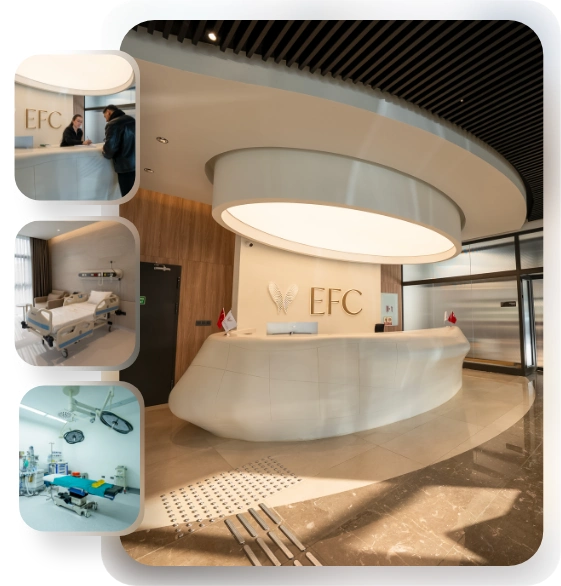
Comprehensive Care: From the First Examination to the Follow-Up Process.
EFC CLINIC is a center of excellence specializing in the most rigorous fields of surgical medicine—from aesthetic surgery to interventional treatments—where every step is carried out with meticulous care. Medical excellence, aesthetic precision, and an uncompromising ethical stance meet on the same line. Our subspecialty-trained specialists aim to achieve natural and reliable results by providing evidence-based care with modern imaging, standardized protocols, and safety systems. From consultation to recovery, your care is coordinated end-to-end with clear communication, transparent planning, and genuine respect for your health.
