
 Türkçe
 Deutsch
 Français
EFC Clinic Eye Treatments 2026: Smart Lens, Excimer Laser, Cataract and More
EFC Clinic is delighted to announce that, following a dedicated meeting with our newly assembled specialist eye surgery team, we are now offering a comprehensive range of ophthalmological procedures at our medical centre. The services now available include smart lens implantation, excimer laser treatment, eye colour change via the FLAAK method, cataract surgery, cornea transplant, retina surgery, strabismus surgery and glaucoma surgery. We are proud to share this exciting development with our social media followers and with our partner agencies worldwide.
This article explains each of the eye surgery procedures now performed at EFC Clinic — who they are suitable for, how they work, and what to expect during recovery. For more information, visit our eye treatments page or book online via our appointment page.
EFC Clinic Eye Surgery Team — A New Chapter
By adding a dedicated ophthalmology unit to our multidisciplinary medical centre in Istanbul, EFC Clinic has significantly expanded the range of specialist care available to both domestic and international patients. Our eye surgery team comprises experienced ophthalmologists who work with the latest technology and internationally recognised protocols, with patient safety and individually tailored treatment plans at the core of every procedure.
Every patient undergoing eye surgery at EFC Clinic receives a thorough pre-operative assessment covering corneal topography, refraction analysis, intraocular pressure measurement, biometry, optical coherence tomography (OCT), and retinal examination. For international patients, existing eye examination reports can be assessed remotely before travelling to Istanbul, allowing preliminary candidacy to be established in advance.
Smart Lens Implantation (Trifocal / Multifocal Lens)
Smart lens surgery resolves both cataracts and spectacle dependence in a single procedure. Trifocal and multifocal smart lenses provide clear vision at distance, intermediate, and near ranges with a single implant, eliminating the need for glasses or contact lenses in the vast majority of patients after surgery.
Who Is It Suitable For?
Ideal candidates include individuals over 40 experiencing presbyopia, patients diagnosed with cataracts, those whose corneal thickness is insufficient for excimer laser treatment, and anyone wishing to correct both distance and near vision in one procedure.
Procedure and Recovery
Surgery takes approximately 15–20 minutes under local anaesthesia with no hospitalisation required. The natural lens is removed by phacoemulsification and replaced with a premium intraocular lens. Most patients begin to see clearly on the first day after surgery; full recovery is typically complete within 2–4 weeks. Sunglasses are recommended during the first week to protect from bright light.
Excimer Laser Eye Surgery — Freedom from Glasses
Excimer laser treatment permanently corrects myopia, hyperopia, and astigmatism by reshaping the cornea. The three main techniques — LASIK, PRK, and LASEK — are selected according to each patient’s corneal structure and individual eye parameters.
LASIK
The most widely performed excimer laser technique. A thin corneal flap is created, the tissue beneath is reshaped by the laser, and the flap is repositioned. Recovery is very fast; most patients achieve clear vision within a day of surgery.
PRK and LASEK
Preferred for patients whose corneal thickness is borderline for LASIK. The laser is applied directly to the corneal surface without creating a flap. Recovery takes 3–5 days, and long-term outcomes are equivalent to LASIK.
Candidacy Criteria
Anyone over 18 with a stable prescription for at least one year and sufficient corneal thickness may be a suitable candidate. Eligibility is confirmed through a detailed pre-operative assessment.
Eye Colour Change – FLAAK Method
The FLAAK (Femtosecond Laser-Assisted Anterior Keratomilyöz) technique permanently changes the natural colour of the eye without coloured contact lenses. A colour filter is precisely inserted within the cornea using a femtosecond laser, leaving the eye’s natural structure undamaged and the procedure fully reversible if desired.
The procedure takes approximately 20–30 minutes and does not require hospitalisation. Follow-up appointments take place the day after surgery, then at one week, one month, and three months. Available colours include blue, green, hazel, light brown, and grey. The most suitable shade is selected in consultation with the treating ophthalmologist based on the patient’s facial features and skin tone.
Cataract Surgery
Cataract is the progressive clouding of the eye’s natural lens, leading to a reduction in visual acuity. If left untreated it can result in permanent vision loss, but it is fully treatable with surgery. At EFC Clinic, the phacoemulsification technique is used — the cloudy lens is removed using ultrasound and replaced with a clear intraocular lens.
Procedure and Recovery
Surgery takes approximately 10–15 minutes under local anaesthesia. Most patients go home the same day. Vision typically improves noticeably within 24–48 hours and full recovery is complete within 4–6 weeks. During recovery, patients should avoid rubbing the eyes, swimming, and exposure to dusty environments.
Cornea Transplant (Keratoplasty)
A cornea transplant involves replacing damaged or diseased corneal tissue with donor cornea. Primary indications include keratoconus, corneal scarring, Fuchs endothelial dystrophy, and advanced corneal infections.
Modern Techniques
In addition to traditional full-thickness transplants, modern lamellar techniques are now preferred. DSEK/DMEK transplants only the posterior corneal layers, while DALK replaces the anterior layers. These approaches deliver faster recovery, fewer complications, and superior visual outcomes compared to full-thickness transplantation.
Retina Surgery
The retina is the light-sensitive tissue lining the back of the eye, responsible for transmitting images to the brain. Retinal surgery is performed for retinal tears, retinal detachment, diabetic retinopathy, macular holes, and epiretinal membranes.
Vitrectomy
The most commonly performed retinal procedure, vitrectomy involves the removal of the vitreous gel and repair of the retina using microsurgical instruments with high-resolution intraoperative imaging.
Laser Photocoagulation
Used to treat retinal tears and conditions such as diabetic retinopathy, laser photocoagulation is an outpatient procedure that seals or destroys damaged areas of the retina using laser energy, preventing further deterioration.
Strabismus Surgery (Eye Muscle Surgery)
Strabismus is the misalignment of the eyes caused by an imbalance in the eye muscles, affecting both children and adults. Surgery corrects the misalignment by repositioning the affected eye muscles to restore proper alignment.
Children are operated on under general anaesthesia; adults usually under local anaesthesia. The procedure takes 30–60 minutes and does not require a hospital stay. Most patients return to daily activities within 1–2 days. Early diagnosis and treatment are particularly important in children to protect visual acuity and prevent amblyopia.
Glaucoma Surgery (Eye Pressure Surgery)
Glaucoma is a serious eye condition caused by elevated intraocular pressure that progressively damages the optic nerve, potentially leading to irreversible vision loss if untreated. Because glaucoma is frequently asymptomatic until an advanced stage, regular eye examinations are essential. Surgery is indicated when pressure cannot be adequately controlled with eye drops.
Surgical Options
Trabeculectomy creates a new drainage channel to reduce intraocular pressure. Tube-shunt implantation involves placing a small implant to regulate pressure. Laser trabeculoplasty is a minimally invasive laser option that improves drainage. MIGS (Minimally Invasive Glaucoma Surgery) encompasses modern, lower-risk surgical techniques. Annual comprehensive eye checks are recommended for those at risk — individuals with a family history of glaucoma, elevated intraocular pressure, or over the age of 40.
Why Choose EFC Clinic for Eye Surgery?
EFC Clinic is a multidisciplinary medical centre in Istanbul operating to international standards. Key advantages of our eye surgery unit include:
- Specialist, experienced ophthalmology team
- Latest-generation laser and microsurgical equipment
- Comprehensive personalised pre-operative assessment and treatment planning
- Airport transfers, accommodation support, and multilingual interpretation for international patients
- Transparent pricing and package treatment options
- Remote post-operative follow-up
For information about eye surgery at EFC Clinic, visit our eye treatments page or reach our team via the contact page. Online bookings can be made through our appointment page.
Frequently Asked Questions
Which eye surgeries are performed at EFC Clinic?
EFC Clinic now performs smart lens implantation, excimer laser treatment (LASIK/PRK/LASEK), FLAAK eye colour change, cataract surgery, cornea transplant, retina surgery, strabismus surgery, and glaucoma surgery.
Is eye surgery painful?
No. All procedures are performed under local or general anaesthesia so there is no pain during surgery. Any mild discomfort afterwards is easily managed with prescribed eye drops and pain relief.
What services are available for international patients?
We offer airport transfers, accommodation support, multilingual interpretation (Turkish, English, French, German), and remote post-operative follow-up. Existing eye reports can be assessed remotely before travelling. Full details are available on our patient services page.
How long do I need to stay in Istanbul?
Excimer laser and FLAAK typically require 3–5 days; cataract and smart lens surgery 5–7 days. Cornea transplant and retina surgery require longer follow-up — 10–14 days is recommended.
Are the results of eye surgery permanent?
Cataract and smart lens procedures are permanent — the implanted lens lasts a lifetime. Excimer laser results are largely permanent. FLAAK eye colour change is permanent but reversible if desired.
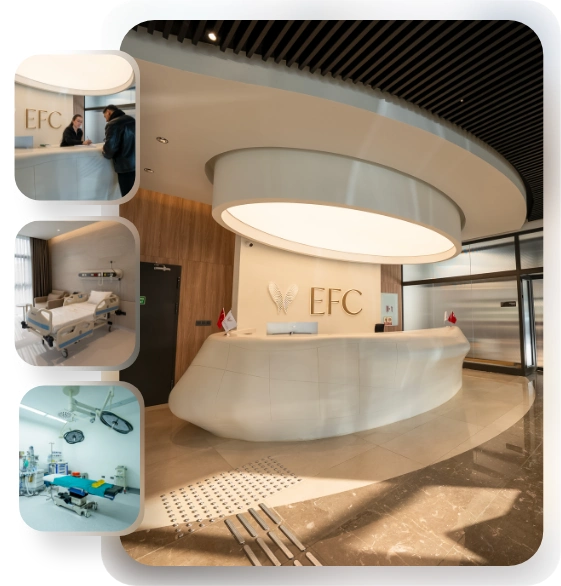
Comprehensive Care: From the First Examination to the Follow-Up Process.
EFC CLINIC is a center of excellence specializing in the most rigorous fields of surgical medicine—from aesthetic surgery to interventional treatments—where every step is carried out with meticulous care. Medical excellence, aesthetic precision, and an uncompromising ethical stance meet on the same line. Our subspecialty-trained specialists aim to achieve natural and reliable results by providing evidence-based care with modern imaging, standardized protocols, and safety systems. From consultation to recovery, your care is coordinated end-to-end with clear communication, transparent planning, and genuine respect for your health.
