
 Türkçe
 Deutsch
 Français
Eye health is an area that directly affects quality of life and can be largely preserved through early diagnosis and correct treatment. Cataract surgery and LASIK have become extremely safe and effective in 2026 thanks to advances in microsurgery and laser technology. In this comprehensive guide we cover what cataracts are, their symptoms, the surgical process, lens options, laser eye treatments including LASIK, and why Turkey has become the world’s preferred destination for eye care.
What Is a Cataract?
A cataract is a condition in which the natural lens of the eye gradually loses its transparency and becomes cloudy. The lens is a clear structure that focuses light onto the retina. When a cataract develops, light cannot pass through the cloudy lens effectively and vision quality deteriorates.
Cataract is one of the most common eye problems associated with ageing. According to the World Health Organization, cataract is one of the leading causes of preventable blindness worldwide. However, full restoration of vision is possible with early diagnosis and surgical intervention. Learn more about cataract treatment at EFC Clinic.
Types of Cataracts
- Nuclear cataract: Develops in the centre of the lens; distance vision is affected first. The most common age-related type.
- Cortical cataract: Begins at the outer layers of the lens and progresses towards the centre; glare and spoke-shaped opacities are typical.
- Subcapsular cataract: Develops at the back of the lens; more common in diabetic patients and after prolonged steroid use.
- Congenital cataract: Present at birth or appearing in early childhood; early intervention is needed to prevent amblyopia (lazy eye).
Symptoms and Diagnosis
Cataracts typically progress slowly and may go unnoticed initially. The most common symptoms include:
- Blurry, foggy or dim vision
- Deteriorating night vision and sensitivity to glare
- Colours appearing faded or yellowish
- Frequent changes in glasses or contact lens prescription
- Double vision in one eye
- Difficulty reading or working at close range
Diagnosis is made through biomicroscopy (slit-lamp examination), visual acuity testing and dilated fundus examination. A comprehensive eye screening at EFC Clinic is completed in a single session.
Cataract Surgery: Phacoemulsification
The gold standard of cataract treatment today is phacoemulsification. In this minimally invasive technique:
- A small 2-3 mm incision is made at the surface of the eye
- The cloudy lens is broken up and aspirated using ultrasonic energy
- A foldable artificial intraocular lens (IOL) is inserted in its place
- The incision typically requires no stitches and seals on its own
The procedure is performed with anaesthetic eye drops; no hospital stay is required. Surgery takes approximately 15-20 minutes. Significant improvement in vision is usually noticed within a few days.
Femtosecond Laser-Assisted Cataract Surgery (FLACS)
In addition to conventional phacoemulsification, femtosecond laser is used in some cases to perform the incision, capsule opening and lens fragmentation with greater precision. FLACS is particularly preferred for complex cases and premium lens implantation.
Intraocular Lens (IOL) Options
The type of lens used in cataract surgery directly affects post-operative vision. The main options are:
- Monofocal IOL: Optimised for distance or near vision; glasses may be required for the other range. The most economical option.
- Multifocal IOL: Provides clear vision at near, intermediate and distance ranges; aims for complete spectacle independence.
- Extended Depth of Focus (EDOF) IOL: Delivers clear vision across a wide focal range; superior night vision compared to multifocal lenses.
- Toric IOL: Also corrects astigmatism in the same procedure.
- Trifocal IOL: Provides clear vision at three distinct focal distances; the most advanced premium lens option available.
The right lens choice is determined only after a comprehensive eye examination and biometry measurements. Learn about all eye treatments at EFC Clinic.
LASIK and Laser Eye Treatments
LASIK (Laser-Assisted In Situ Keratomileusis) is a laser eye treatment that permanently corrects myopia, hyperopia and astigmatism by reshaping the cornea. Unlike cataract surgery, no lens replacement is performed; the shape of the corneal surface is reorganised with a laser.
How Is LASIK Performed?
- A thin flap is created on the corneal surface
- An excimer laser precisely reshapes the tissue beneath the cornea
- The flap is repositioned; no stitches are required
The procedure takes approximately 15 minutes per eye. Most patients achieve clear vision on the day of surgery or the following day.
LASIK Alternatives
- PRK (Photorefractive Keratectomy): Laser treatment without flap creation; preferred for patients with thin corneas or athletes.
- SMILE (Small Incision Lenticule Extraction): Flapless, minimally invasive next-generation laser technique; fewer dry eye and glare side effects than LASIK.
- ICL (Implantable Collamer Lens): An additional lens implanted inside the eye for high prescriptions where laser is not suitable.
Recovery Process
After Cataract Surgery
- First 24 hours: Mild burning, watering and blurriness are normal; avoid rubbing the eye
- Days 2-7: Noticeable improvement in vision; continue prescribed eye drops
- Month 1: Vision largely stabilises; glasses prescription can be updated
- Month 3: Full recovery is complete
After LASIK
- First 24 hours: Burning, watering and light sensitivity; rest is advised
- Days 1-3: Rapid improvement; most patients can drive the following day
- 1 week: Follow-up appointment; most activities can be resumed
- 1 month: Vision fully stabilises
Why Turkey and EFC Clinic?
Turkey has become an increasingly preferred destination worldwide for eye surgery, combining advanced equipment, experienced specialists and accessible costs. The same quality eye operations can be performed in Turkey at 50-70% lower cost compared to Western Europe and the USA.
- Experienced ophthalmologists and retinal surgeons
- Latest technologies including femtosecond laser and SMILE
- Premium trifocal and EDOF IOL options
- Comprehensive pre-operative examination and biometry
- Patient coordination in TR / EN / FR / DE
- Transfer, accommodation and remote follow-up support for international patients
Learn about our international patient services or meet our specialist doctors.
Frequently Asked Questions
Is cataract surgery permanent?
Yes. The implanted artificial lens is permanent. In rare cases, cloudiness may develop in the posterior capsule; this is resolved with a simple laser procedure (YAG capsulotomy).
Is LASIK suitable for everyone?
No. LASIK may be contraindicated in patients with insufficient corneal thickness, large pupil diameter, high myopia or certain systemic conditions. A comprehensive pre-operative examination is essential to evaluate alternatives.
Is cataract surgery painful?
No. The procedure is performed with anaesthetic drops and no pain is felt. Mild discomfort after surgery resolves within 24-48 hours.
Can both eyes be operated on at the same time?
Generally, eyes are operated on separately with a one-week interval. However, same-day bilateral surgery may be performed in some cases depending on the centre and patient conditions.
Can vision deteriorate again after LASIK?
The effect of LASIK is permanent. However, presbyopia developing after age 40 may require reading glasses; this is a natural ageing process, not a failure of LASIK.
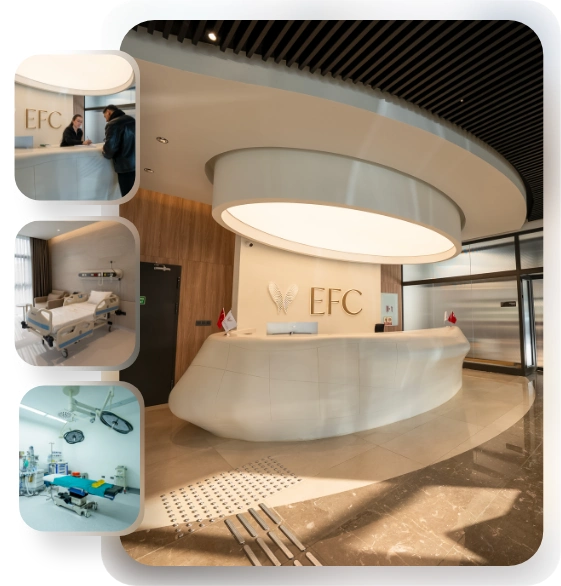
Comprehensive Care: From the First Examination to the Follow-Up Process.
EFC CLINIC is a center of excellence specializing in the most rigorous fields of surgical medicine—from aesthetic surgery to interventional treatments—where every step is carried out with meticulous care. Medical excellence, aesthetic precision, and an uncompromising ethical stance meet on the same line. Our subspecialty-trained specialists aim to achieve natural and reliable results by providing evidence-based care with modern imaging, standardized protocols, and safety systems. From consultation to recovery, your care is coordinated end-to-end with clear communication, transparent planning, and genuine respect for your health.
